Thursday, April 12, 2012

Review: The Secret World Of Arrietty (2012)


"Human beings are dangerous. If we're seen, we have to leave."


*This review concerns the English dubbing of the film and thus will reference the US version’s titles, translation, and release dates*

Japan’s Studio Ghibli produces some of the finest films in the world. Since 1985, the studio has been churning out quality picture after quality picture. Their hard work culminated at the 75th Academy Awards where Studio Ghibli’s Spirited Away won the Academy Award for Best Animated Feature, the very first time (and one of only two overall) for a non-US film to win. I love the films Ghibli create. I’ve seen them all and, save for one (I’m looking at you Pom Poko), I highly recommend checking out their full catalog. Studio Ghibli’s founder and key player is Hayao Miyazaki who wrote and directed 9 out of 18 of the studio’s films and produced four others (of those, he wrote the screenplays for two of them). The man has a perfect track record and is easily one of my favorite directors. For The Secret World Of Arrietty, Miyazaki serves as a developing planner and the co-writer of the screenplay. Miyazaki’s usual themes of environmentalism and feminism are still interwoven throughout the story (based on Mary Norton’s The Borrowers), but first time director Hiromasa Yonebayashi puts his own touches to this heartwarming and exciting tale.


The plot revolves around Arrietty, voiced by Bridgit Mendler, and her family of “little people” or “borrowers” who live in the cupboards of a human family’s house. They take small things the humans would never notice/miss in order to survive. They range from a single sugar cube or one tissue or the tiniest scraps of fabric. When a young sickly boy, Shawn (voiced by David Henrie), spots Arrietty, her family must make the difficult decision to either stay in the comfort of their home and risk more humans finding them or traverse harsh conditions to find a new one. It’s a fun story that does an excellent job of making you care about the characters.


The voice acting is good, but not amazing. David Henrie in particular seems out of place and lacking. It’s interesting to note that Disney (who distributes all of the Ghibli films outside of Japan) seems to be using their position in casting the English voice actors to use it as a platform for their own Disney channel stars (both the two mentioned earlier are from Wizards of Waverly Place, while 2009’s Ponyo had both Noah Cyrus and Frankie Jonas in the main roles who’s older siblings were on Disney’s biggest shows at the time). I only mention this because earlier releases saw big names like Christian Bale & Emily Mortimer (2005’s Howl’s Moving Castle), Claire Danes & Billy Bob Thornton (1999’s Princess Mononoke), and Michael Keaton & Cary Elwes (1992’s Porco Rosso). I’m not sure if Disney is getting less and less of a budget to attract big stars or their just choosing young stars from their own roster, but Ponyo and Arrietty both had much weaker voice acting than the previous Ghibli dubs.


What is amazing, however, is the animation and attention to detail. Not since Pixar’s Toy Story have we been able to see such a tiny world seem incredibly massive. From a drop of dew on a leaf, to the heft of a single sugar cube, to the sprawling forest that is the human’s backyard, The Secret World of Arrietty creates a grand narrative out of the smallest details. The animation is bright and fluid, as it always is with Ghibli films. Whether Arrietty is running from the house cat through the grass or a crow on the roof, the animation never rests and is absolutely breathtaking.


Of final note to Ghibli aficionados like myself, The Secret World of Arrietty marks the first major Studio Ghibli release to use a composer other than the veritable Joe Hisaishi. Instead, director Yonebayashi went with French singer Cécile Corbel. Trading Hisaishi’s piano for harp lines, Corbel creates lush atmospheres with tinges of both Celtic and Japanese sounds. Ultimately, I think it works. A new director’s fresh take on a classic story matched with a new composer to give a unique and different feel to anything else Studio Ghibli has released.

8/10


Tuesday, April 10, 2012

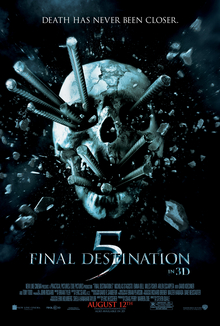
Review: Final Destination 5 (2011)


"Death... doesn't like to be cheated."


Quick, scroll down and check the score out. Go ahead, I’ll wait. Surprised? Yes, Final Destination 5 is actually quite good. Is it ridiculous? Yes. Is it stupid at times? Yes. Does that stop if from being entertaining? No. First things first, I did not see this in 3D so I cannot comment on those effects. Second and perhaps surprisingly, this is only one of two Final Destination movies that I’ve seen (the other being number 2). So how is it that someone who’s only seen one other film in the franchise and in general dislikes horror/gore movies somehow finds this good? Well to put it simply, Final Destination 5 is filled with gruesome fun. From the expertly staged opening disaster of a suspended bridge collapse to the succession of violent deaths of the main cast, Final Destination 5 gets all the pieces right.

The plot is pretty much the same as the other four movies; one person gets a premonition of a coming disaster and “saves” a bunch of people by keeping them away from whatever catastrophe the writers throw at them this time, but of course death has a way of catching up everyone, in the most grisly ways imaginable. It’s a tried and true formula in both the franchise and horror films in general, but Final Destination 5 keeps the film moving and doesn’t get bogged down in trivial matters like “realism.”

As with all the Final Destination movies, they do a good job of building suspense for the kills. We, as the audience, know that these people will die (especially after 4 previous films) so it’s admirable that the script and direction can still keep us on the edge of the seat wondering which knick-knack will set off a chain of events that, ultimately, will result in a CG bloodbath (most of the deaths have great foreshadowing or a thematic connection to how they were ‘supposed’ to die in the bridge accident as well).

Probably the biggest highlight of number 5 though, is how it really ties the franchise together. Towards the end we get a montage of all the previous deaths throughout the past four movies, but what really shines, are the small moments that really connect the movies; the plane from the first movie, the logging truck from the second, the “Hice Pale Ale” beer that is seen throughout the films, background appearances by other Final Destination characters, and more just do a great job of giving a small nod to any fans of the series watching. The ending is by far the best thing about the movie and without giving away too much, it firmly serves the darker tone the first movie originally set out to depict. We’d be lucky if all horror movies were this well thought out.


6/10


Tuesday, April 3, 2012

Review: Lost In Translation (2003)


"...Is that all he said?"


Lost In Translation is such an apt title. Yes, the film deals with people attempting to overcome a language barrier, no- a cultural one, in a foreign place, but what the film is really about is people who are lost. Lost in work, lost in relationships, lost in a mid-life crisis, lost in life. And yet among all these people drifting aimlessly, two very different people find comfort in one another.

Bill Murray is an aging film actor, named Bob, in Japan to shoot a whiskey commercial to make a cool $2 million. Scarlett Johansson is Charlotte, a newlywed woman whose continually left behind in the hotel room by her husband (the always awesome Giovanni Ribisi), a celebrity photographer on assignment in Tokyo. Much of the first half of the film shows Bob and Charlotte in desperate loneliness. When the two finally do meet, the forge a charming friendship and take ease that neither of them understand the culture here in Japan.

The first glimpses we see of Tokyo are through Bob dealing with culture shock. While shooting his whiskey commercial, Bob is given comically long directions from his Japanese director, yet the translator simply says, “He wants you to turn, look in camera. O.K.?” Scenes like this give the film it’s comedic edge. And this is much needed; from the get-go Bob is painted as being bored with his life, yes he is rich and successful, but somehow he’s not happy. Between the brief glimpses into Bob’s mid-life crisis and a heartbreaking phone call confessional from Charlotte questioning if she is happy with the man she married, Lost In Translation is overall a somber movie.

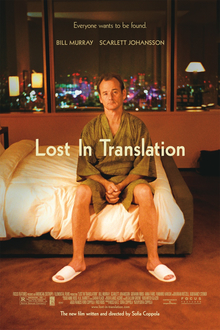
Director Sophia Coppola also wrote the screenplay and does an incredible job balancing between laughter and the serious beats that make the film a poignant one. As a director, she’s no slouch either; the film moves quickly enough yet we are treated to some shots that Coppola is not afraid to hold on screen for a second more than a lesser director would. These scenes usually revolve around windows: Charlotte looking out during the day, Bob coping with insomnia at night (i.e. the theatrical poster), or both of them at a karaoke bar. These usually leave us with beautiful shots of Tokyo at night and as anyone who knows me well enough, my favorite cinematography involves cities at night (Heat, Drive, The Dark Knight, Collateral). Anyway, these windows also serve as metaphorical “windows into the heart” as these scenes always show the character’s true feelings/self. Lost In Translation has so many layers to it that practically anyone can watch it and take something away from it. This just shows the talent of Sofia Coppola. Like her father, directing is in her blood and she has an undeniable talent for it. This was Coppola’s second feature film and it earned her an Academy Award for Best Original Screenplay, as well as nominations for both Best Picture and Best Director (which she was the first American woman to be nominated for and remains the youngest). Going through life we’re bound to lose ourselves once in a while, but as Lost In Translation shows us, sometimes it takes being lost to find what we need.


7/10


Sunday, March 18, 2012

Analysis: The Town's Alternate Ending


"I'll see you again, this side or the other."


*This post is different from usual and contains spoilers*


On March 6th of this year, Warner Home Video released the ‘Ultimate Collector’s Edition’ of Ben Affleck’s 2010 crime/drama The Town on Blu-Ray. The major draw of this re-release is the inclusion of an alternate ending. When The Town was released in 2010 it easily made my “top 10 list” of that year, and the subsequent Blu-Ray release (which included an extended cut adding an additional 28 minutes of footage) was a day one purchase. Fast-forward to today and it still remains a film I adore. So of course I had to see Affleck’s alternate ending.

A quick refresher on the original ending: Ben Affleck’s character, Doug MacRay a professional bankrobber from Charlestown, is on the run from Jon Hamm’s Special Agent Adam Frawley and his FBI agents after the Fenway Park heist which resulted in the death of Doug’s crew/friends. The only thing he has left is the take from the heist and his love for Claire Keesey, portrayed by Rebecca Hall, who feels betrayed when she finds out Doug was one of the assailants to rob her bank and take her hostage. Despite this, she still loves him and secretly tips him off about the Feds at her place and the film ends with Claire finding the stolen money buried in her garden with a note from Doug saying she would find a better use for it then he would. The final shots show that Claire donated the money to renovate the hockey arena that Doug once played in, while Doug is seen looking over the water at sunset, safe but alone.

This ending was great in that it didn’t let the two lovers live happily ever after together, forcing the viewer to reconcile that when you live that type of life, you cannot have everything. The music is perfect, the shot composition and cinematography of Doug at sunset is beautiful, and Doug’s monologue over top of all this culminates in such a way that the ending feels real and earned. Basically, it was going to be a tough ending to top.

However, despite being the butt of many jokes, Ben Affleck has proven to be an incredible director despite only having two credits to his name (this, and 2007’s Gone Baby Gone), and I knew I was in for a well thought-out alternative rather than a cheap one that wouldn’t fit in the context of the film.

In the alternate ending, all the actions play out almost the same. After Claire warns Doug of the FBI at her place, we follow Doug leaving, something we did not get in the original. However, when Doug turns the corner to his car, he is confronted by three thugs he and his friend Jem (Jeremy Renner) had attacked earlier in the movie (one of whom has a broken leg courtesy of them). There’s brief dialog here that is incredibly intense and the tight shot focus and quick, back-and-forth editing force us to realize what Doug is realizing as he looks up in the sky and sees a plane leave; he isn’t going to make it. As the main thug holds his gun up to Doug, toying with him, Doug, defiant to the end, asks him about his leg. The thug immediately shoots him several times and Doug falls down and dies looking up at the sky, finally seeming at peace. The film continues with Claire seeing a news report that Doug was murdered. After this, the original ending resumes with Claire finding the money and the note buried in her garden. This time his words have a different weight and meaning to them, as she knows he is dead. The final shot is her at the refurbished ice rink watching kids play hockey, presumably coming to terms with Doug’s death and ready to try and move on. What’s truly remarkable of this version is it really changes the meaning of the film. While the original ending was about Doug and his personal journey with escaping his past life of crime and being able to leave Charlestown, this alternate ending infers that these career criminals can never escape their ‘birthright’ and the film becomes a story about this town and it’s hold over it’s residents. It’s dark, chilling, and, ultimately, an absolute joy to see how one change in the ending scene can completely alter an already incredible film.

Alternate endings are a tricky bag. They can be pointless (EuroTrip) or they can make the original ending seem terrible in comparison (I Am Legend). The Town somehow gives us two great endings that fundamentally change how we view the film. I can’t say which ending I prefer, but I’m certainly glad to have them both.


Thursday, March 15, 2012

Review: Puss In Boots (2011)

Films like this are always hard to review as there really isn't much to say. Puss In Boots is the very definition of average. There is nothing tremendously good or bad about the film. The story is nothing new and the voice acting simply gets the job done no more, no less (Zach Galifianakis is the closest to a memorable performance). The writing is enjoyable at moments, agonizing at others (the Fight Club and James Bond references are great, if not cliched at this point). Some jokes land, while others completely miss. The one thing that's exceptionally well done is the animation, which unfortunately is the case for every other CGI animated movie nowadays. Overall, Puss In Boots has some really nice moments and some really underwhelming moments. It's neither good nor bad.


5/10


Sunday, March 4, 2012

Review: My Week With Marilyn (2011)


"In a spin,
loving the spin I'm in,
under that old black magic called love"


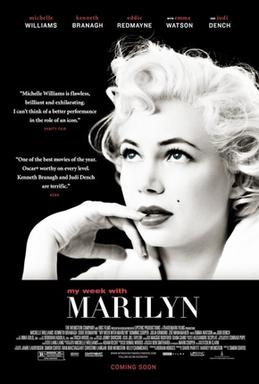
I have yet to see a Marilyn Monroe movie. Somehow in my 25+ years of living, I’ve missed out on Some Like It Hot, or All About Eve, or Bus Stop. It’s clearly a major misstep in my film education, yet it doesn’t make My Week with Marilyn any less enjoyable for me. Simon Curtis’ film follows an aspiring filmmaker, Colin Clark, portrayed by Eddie Redmayne, who gets a job on the production of The Prince and the Showgirl. What follows is Colin’s account of his time growing close and falling in love with Marilyn Monroe (Michelle Williams). What’s great about this direction is that the character of Colin is new to this, just as we are; he’s an outsider looking in, trying to reconcile his understanding of Marilyn the “Icon” and Marilyn the person. It’s a fascinatingly different approach to anything I’ve ever seen about Ms. Monroe.

Much like Leonardo DiCaprio in J. Edgar, the main reason to see this film is Williams’ performance. The always incredible Michelle Williams is given the incredulous task of depicting one of the most iconic women in cinema history and she admirably rises to the occasion. Williams embodies Monroe wholly; from her look down to her voice even to the opposing dichotomy that is Marilyn the “Icon”: she’s both fragile and powerful, innocent yet sensual. It’s a tough character to understand; we don’t know her so it’s left to history and imaginations to create this image, yet somehow it seems right. Curtis and screenwriter Adrian Hodges haven’t set out to teach us anything new about Marilyn, just to give us a brief, entertaining look at a Hollywood legend around the peak of her career and close to the end of her life. The cinematography, editing, and score are all fine. Nothing exceptional or breathtaking, but they serve the story and to that end, are successful. Aside from the aforementioned praise, Williams also gets to dabble in singing some of Ms. Monroe’s iconic songs. In a chilling coda, we are treated to a somber rendition of ‘That Old Black Magic’ that quite appropriately sums up Colin’s, and our own, journey with the quintessential American sex symbol.


Sunday, February 26, 2012

Ryan's Top 20 Films of 2011


20) Shame
- An intense portrayal of a sex addict, Michael Fassbender’s performance is both captivating and difficult to watch. Under the direction of Steve McQueen, Fassbender’s sexual addiction comes off as any other addiction would: something that must be done, with little to no enjoyment. For me, it’s very reminiscent of Darren Aronofsky’s Requiem For A Dream in that it is an incredible work of art that I hope never to see again.

19) A Dangerous Method
- Between X-Men: First Class and the aforementioned Shame, 2011 has been Michael Fassbender’s year. David Cronenberg’s A Dangerous Method is fascinating look at the beginnings of psychoanalysis and analytical psychology. While that sentence might not sound fascinating, Cronenberg’s vision is just great. Along with Fassbender, co-stars Viggo Mortensen and Keira Knightley do a terrific job portraying these historical figures. Anyone interested in either great films or the history of psychology’s two most influential figures should check this out.

18) Martha Marcy May Marlene
- Martha Marcy May Marlene is a haunting psychological thriller that is purposefully ambiguous. Elizabeth Olsen portrays a young girl, Martha, who has just run away from an abusive cult and into the life of her estranged sister. Olsen is easily the highlight of the film, as her powerful performance holds up what might otherwise be a hard to understand character in a confusing situation. Co-star John Hawkes delivers an equally impressive performance as the mysterious leader of a cult. Any confusion we could have about why Martha is drawn to this group is quickly defused when Hawkes is on screen. He holds a power over these people and the viewer as well.

17) 50/50
- Cancer and comedy together is more often than not a recipe for disaster (see: Funny People). 50/50 however walks the perfect line between genuinely heartfelt moments and clever humor. Joseph Gordon-Levitt continues to prove he has the potential to be a major Hollywood player, while Seth Rogen finally finds himself in a roll that lets him shine.

16) J. Edgar
- Clint Eastwood’s J. Edgar Hoover biopic is by no means a perfect film. With confusing time jumps and a messy script, J. Edgar is unlikely to find a lot of love in most circles. However, Eastwood is still a fantastic director and both the cinematography and editing is top notch. Obviously the highlight of the film is Leonardo DiCaprio’s mesmerizing performance, but it looks like Leo will miss out again this award season.

15) Another Earth
- Another Earth is a science-fiction film that explores the concept of second chances. Star Brit Marling and director Mike Cahill co-wrote the script that takes the concept of a mirror image Earth appearing (with mirror-twins of everyone) and shrinks it down into a riveting interpersonal drama. Another Earth evokes a mood few sci-fi films achieve.

14) Source Code
- In 2009 Duncan Jones made his directional debut with Moon, which is one of my favorite films of all time. This past year he returned with Source Code, a sci-fi thriller that manages to provide heart-pounding action sequences yet still find time to explore philosophical questions. Are our lives predetermined? Are there alternate realities? Moreover, what is reality? Duncan Jones continues to prove he is one of the best new directors.

13) Melancholia
- The opening of Melancholia is various shots in super slow motion depicting the end of the world set to Wagner’s Prelude to Tristan and Isolde. It is simultaneously beautiful and depressing. It also sums up what the film is about. Melancholia is split into two acts; the first focuses on a newly wed couple with the bride battling depression. The second (and far superior) act focuses on her sister and the coming apocalypse. Director Lars von Trier crafted this film wonderfully but it’s not without it’s shortcomings: act one moves at a snail’s pace and ultimately feels less needed than act two. Still, the end of the world has never looked this gorgeous.

12) Moneyball
- A sports drama that doesn’t require a love (or knowledge) of baseball is made all the better by being based on a true story. Moneyball finds Brad Pitt at the top of his game and introduces Jonah Hill as a serious actor. Cinematographer, Wally Pfister (see: Inception, The Dark Knight) always impresses and genuinely gives the film an incredible look. I personally don’t like baseball, yet this film is endlessly fascinating and follows a true underdog story.

11) War Horse
- Steven Spielberg’s WWI epic, War Horse, continues his fine tradition of making classic films. A smart script and a memorable score (by none other than John Williams) tell the tale of a horse separated from his owner in the midst of World War I. The true star of this film is the horse itself and, somehow, Spielberg makes us love that creature. The final scene of the movie contains the most beautiful cinematography of any film of the year.

10) Contagion
- Contagion is a tense, fast-paced medical thriller that follows an ensemble cast and a virus that threatens humanity. Steven Soderbergh has become a master of the multi-protagonist story (see: the Ocean’s trilogy, Traffic) and that is no different here. It’s a delight to see so many artists giving great performances. Cliff Martinez’ pulsating score keeps the film moving and keeps the viewer on the edge of their seat.

9) The Tree Of Life
- If Melancholia detailed the end of the world, Terrence Malick’s The Tree Of Life explores the birth of the universe and the meanings of life. While something of this scope was bound to fail, Malick’s effort is still a wonderfully enchanting piece, well worth repeated viewings. Brad Pitt’s portrayal of a loving yet stern father and Jessica Chastain as the ever-gentle mother in the 1950’s provides the anchor in a narrative that freely jumps around. Sean Penn’s performance, however, leaves a bit more to be desired. For the free-form “creation” sections, we are treated to non-CGI special effects that are very reminiscent of 2006’s The Fountain. Ultimately, The Tree Of Life can be summed up in one word: breathtaking.

8) The Girl With The Dragon Tattoo
- David Fincher has yet to make a bad film. Is this his best work? No, maybe not but it is still a Fincher film and you can tell that within the first 5 minutes. The Girl With The Dragon Tattoo oozes with brutal darkness. Like much of Fincher’s work, there is a determined hunt to catch a killer. But unlike Se7en and Zodiac, Dragon Tattoo has Rooney Mara in an unstoppable performance. As fascinating as the story is and as good as Daniel Craig may be, Mara owns every scene she’s in with a quiet rage.

7) The Ides Of March
- George Clooney is unstoppable. The Ides Of March, a political thriller, sees Clooney as director, producer, screenwriter, and actor and he excels in all departments. Clearly years of being a great actor has given him insight into directing actors, as Ryan Gosling is in top form. Aside from 2010’s Blue Valentine, I had never really expected much from Gosling, but this year he has cemented himself as a true artist and someone that I will gladly watch in the future.

6) The Artist
- Who would have guessed that one of the best films of 2011 would be a silent, black and white picture about late 1920’s/early 1930’s Hollywood? I’ve always loved the look of black and white films and The Artist does not disappoint. Acting, to me, is completely different in the world of silent cinema, yet Jean Dujardin and Bérénice Bejo’s performances wouldn’t seem out of place in the heyday of silent films. Dujardin and Bejo exude a charm that makes them impossible not to like. The Artist is an absolute joy to watch.

5) Warrior
- In 2010 we were given The Fighter, an emotionally charged boxing film that was very good. Previews for Warrior seemed to make it look like The Fighter only with MMA instead of boxing. On some levels, that’s probably true: both films deal with family and insurmountable odds and an excellent supporting cast. What makes Warrior stand out so much more (aside from Tom Hardy, Joel Edgerton, and Nick Nolte's powerhouse performances) is an incredibly entertaining and well-written story with masterful pacing by director Gavin O’Conner. The three leading men feel like fully realized characters with their own distinct flaws and strengths. The film is constantly building up tension, so when the film reaches it’s climax, it’s impossible not to be caught up in it all.

4) Midnight In Paris
- Woody Allen has been making films for six decades and Midnight In Paris stands as absolutely one of his best. A charming romantic comedy, Midnight In Paris follows Gil (Owen Wilson in the best performance of his career) as he is whisked from modern day Paris, to Paris of the 1920’s. The film never attempts to explain how he is able to travel back in time and the film is stronger for not attempting to do so. Co-star Marion Cotillard is stunning as usual and the scenes between her and Wilson are delightful. The supporting cast embodies 1920’s Paris and the whimsical score complements the scenery perfectly.

3) The Descendants
- The Descendants somehow manages to be both hilarious and deeply moving. “Dramedies” tend not to work or skew one way or the other, but Alexander Payne’s film walks the line perfectly. George Clooney is phenomenal here. Its nice seeing Clooney at his best and the rest of the cast (Shailene Woodley, especially, is incredible) give some amazing performances. The dialog is tightly written, the music is perfectly suited to the on-screen drama, and the shot composition makes everywhere seem new and fresh.

2) Hugo
- Martin Scorsese’s Hugo is a love letter to early cinema masquerading as a kid’s adventure flick. As a fan of both Scorsese and cinema in general, I can’t help but love this film. Wonderful performances from Asa Butterfield and Chloë Grace Moretz prove that being a child actor doesn’t mean you can’t enthrall the viewer. Sir Ben Kingsley is stunning in his portrayal of famed film pioneer Georges Méliès. If you have not seen any of Méliès’ work, fear not Scorsese perfectly recreates some of his most iconic scenes for a new generation of filmgoer to enjoy. Also of note is the ideal use of 3D filmmaking technology. The 3D in Hugo seems purposeful and magical, not some cheap gimmick. There’s a certain appeal of seeing a modern filmmaking innovation tell the story of early cinematic innovation. Martin Scorsese has made a career of iconic films and from the looks of Hugo, he just keeps getting better at his craft.

1) Drive
- What can I possibly say? Drive is a perfect film. No question about it. From Nicolas Winding Refn’s masterful direction, to the astounding performances by all involved (particularly Ryan Gosling and Albert Brooks), to a pace-building electropop soundtrack by Cliff Martinez, to perfectly timed edits, to the very definition of perfect cinematography (from Newton Thomas Sigel), Drive is a masterpiece in every sense of the word. There are numerous scenes filled with stylish aesthetics and subtext, but one in particular stands out: the elevator scene. Without spoiling anything, it is the most powerful section in the film and ultimately, I believe it ranks as one of the most iconic scenes in all of cinema.